
You can also connect with us on:
Leadership Solutions: Executive Coaching and Leadership Development specializing in Strategy Development and Implementation
  • Home
  • About
  • Coaching
    • Coaching Offer!
    • How I work and why you should work with me
    • The Benefits of Coaching
    • Effective Teams
    • Executive Coaching
    • Coaching and Mentoring: Developing Managers as Coaches & Mentors
    • Difficult Team Conversations
    • Choosing a Coach
  • Strategy
    • What is Strategy? >
      • What it takes to make a good Strategy
      • Diagnosing the internal environment
      • Figuring Out How to Reach the Promised Land
      • Strategy: External Analysis
      • The Competitive Environment
      • Defining the Challenge and Creating the Guiding Policy
      • WIGs, Scoreboards and Tracking Progress
    • Strategic Leadership >
      • Strategic Thinking
      • Strategic Thinking (cont.)
      • Strategic Acting
      • Strategic Acting (cont.)
      • Strategic Acting (cont.)
      • Strategic Influencing
      • Strategic Influencing (cont.)
      • Strategic Influencing (cont.)
      • Strategic Leadership Teams
      • Strategy as a Learnining Process
      • Summing Up Strategic Leadership
    • Strategic Thinking >
      • What is Strategic Thinking?
      • Strategic Thinking as a Discipline
      • Where to Play and How to Win
      • Bucking an Industry Norm
      • Replicating Pockets of Excellence
      • Questions about Strategic Thinking
  • Leadership
    • Developing Business Leaders
    • Personality and Business
    • Self-Leadership >
      • Selling when you are not a Sales Person
      • Meetings! Bloody Meetings! Be Mindful
      • Resilience. How Resilient are You?
      • Resilience: Build your Own
      • Build Your Team's Resilience
    • Leadership >
      • #UselessLosers
      • Leadership is Exercised One Conversation at a Time
      • Presenteeism - Doing more harm than good
      • 5 Steps to Develop your Leadership Skills
    • Culture Change
  • Clients
    • What Our Clients Say >
      • What a Massive Shift
      • Our small part in the fight against Corruption
  • Articles
  • Contact

Leaders are Dealers: Power

10/6/2015

0 Comments

 
weight-lifting, power
This series of 12 articles is focussed on assisting leaders to tap into their inspirational, visionary talents when the business environment is tough.  To read previous articles in this series, click here. This articles examines power and looks at ways of establishing and exerting power in a way that builds the team and enables achievement of the vision.

A leader is a dealer in power. Real leaders know that the most damaging thing to any organisation is when people are frustrated by having severe constraints on their power – that is, they feel powerless. Power is very simply “the ability to act”. When a leader shares power, and pushes it down so that people can act within appropriate limits of authority, it assures that appropriate actions are taking quickly in order to solve problems, exploit opportunities and mitigate threats. Power is the organisation’s blood supply – it keeps it moving and energised and gets oxygen and nutrients to all parts of the body. However, when the arteries get blocked because of severe power constraints, it causes organisational aneurisms. One of the paradoxes of leadership is that the more the leader shares power, the more power he has – he has the power of many, rather than the power of one.

Using the Levels of Initiative below, decide at what level you want each team member to make decisions. Challenge yourself to make it one level higher than feels natural to you. If you are setting the level lower because a team member is learning, by when do you want them moving up a level? And up two levels? Now discuss your expectations with each team member and agree on how you will support them so that they are able to act with confidence..
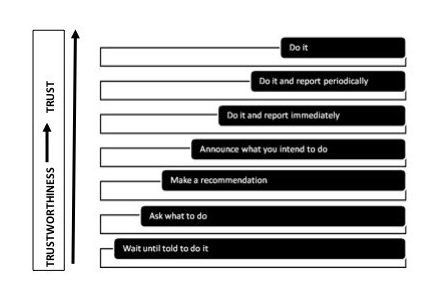


levels of initiative
Let me know how exercising power in this way empowers your team.  Send me an email.

0 Comments

Leaders are Dealers: Pride and Humility

9/28/2015

0 Comments

 
achievement
We have previously dealt with trust, influence, self-control, discipline, results and hope (or inspiration).  Each article contains suggestions, exercises or approaches that you can implement in order to address these areas. To catch up on the previous articles in this series, follow this link.  In this article, we examine the concepts of pride and humility in the context of the leader and his/her team. 

A leader is a dealer in pride. This is not arrogance. It is based on the understanding that the team that is proud of itself, its achievements and its members will constantly strive to win. He talks up his team and makes sure that they celebrate their successes. He looks for opportunities to give recognition, and focuses on what is right in the team whilst quietly addressing what is wrong or needs fixing. His team has no doubt that he is proud of them and, as a result, they take continued pride in excelling.

Are you proud of your team? How would they know? How do you celebrate successes with your team? What is worth celebrating right now? How will you do it?

A leader is a dealer in humility. She knows that any success that she may achieve is because of the collective effort of the team – and she shares the glory with the team. In fact, very often she will stand back and allow the team to bask in the glory of their success, with little need to have the limelight all to herself. She will acknowledge the collective efforts of the team at every opportunity, and ensure that everyone knows that the team is the key to her success.

What successes have you enjoyed that should have been shared with the team? What will you do now to put it right? What will you do next time? What can you do to make sure that your upline knows how great your team is?

The next article in this series of twelve will look at the concept of power and how to exercise it in a constructive way.  If you have any feedback on your progress that you would like to share, email me.

0 Comments

Leaders are Dealers: Pace

9/22/2015

0 Comments

 
Running, runner
In the previous article, we looked at the constructive exercising of power.  Another challenge for the leader is to maintain the momentum when times are tough, and this is when clarity of vision is vital.  If you’ve missed previous articles in this series, you can catch up by following this link.

A leader is a dealer in pace. She gets things moving and keeps things moving. She knows that energy and momentum are critical in achieving results. She works fast herself, and she expects her team to also work quickly. She knows that lethargy is a killer, and makes sure to keep things pacey. She knows that gradual improvement is not good enough, and so fosters change and growth at a pace that stretches the team but does not overwhelm them. You know this leader – she walks quickly, thinks quickly, acts and decides quickly and works quickly. She knows that if change is to happen, it must happen quickly – change that is dragged out creates far more pain and resistance than change that is quick – and she keeps it moving until it is done.

Think about changes you wish to make. Are you happy with the pace at which change is happening? If it is slower than you would want, what is the hold up? Is it you? Are you slowing things down on the assumption that this will make it easier for the team? What could you and the team do to pick up the pace?

How are you doing so far?  Send me an email to let me know where you have experienced the most challenges in terms of implementing new practices and approaches.

0 Comments

Leaders are Dealers: Results

9/22/2015

0 Comments

 
results, growth
This is the sixth in a series of leadership articles dealing with those challenging times when inspiration deserts the leader, and the vision seems vague and irrelevant to what is curerntly going on in the business.  To read the previous articles, with their practical advice, hints and tips, click here.

A leader is a dealer in results. This is all about winning, and the leader is the winning captain. She finds a way for the team to win. By producing results and delivering superior performance, this leader ensures that the best people are in the team and stay in the team. She also ensures that the team is constantly pushing for improvements. They harness the collective energy of the team in pursuit of the vision. They pull people together when things get tough. They know that for every problem, there must be a solution – it just takes the collective effort of the team to find that solution. This leader knows that, in order for the team to succeed, it must include a diversity of talents, skills and thinking styles – people who make up for her own gaps and weaknesses. She knows that if she surrounds herself with good people, the team will win.

How do you keep the team focused on results? And when you are not getting the results you are looking for, how do you problem solve? Do you get the team around a table and wrestle with it until you find a solution?

What problems have you and the team been living with because they have been around so long that you came to believe they were unsolvable? What will you do about them?

I trust that you are seeing a difference in yourself, your team and in the organisation after having implemented the exercises and approaches that I have suggested.  Send me an email to let me know how you’re doing.


0 Comments

Leaders are Dealers: Trust

9/7/2015

0 Comments

 
Trust
In previous articles, we have dealt with the impact of hope (inspiration), discipline, influence, and self-control on a leader’s ability to re-connect with the vision and to be an inspirational leader.  If you would like to read these articles, please follow this link.

A leader is a dealer in trust. It is through the actions of the leader that an organisation becomes a safe place to be –safe enough for team members to take risks and push the boat out. The team needs to know that the leader has their back. Only if they know this will they put themselves on the line, take tough decisions and push the limits of their creativity and innovation. In a safe environment, where team members are acting in unison, guided by a compelling vision, and supported by a trustworthy leader, people will drop their guard and suspend their need to cover their backs – only when this is true will they dig really deep and give their all. If they believe that they may be hung out to dry, they will inevitably play it safe – and sure fire guarantee of mediocrity.

When was the last time a really big idea came from your team? When was the last time your team challenged you or disagreed vigorously with you? Or do they play it safe and remain polite? Not a good sign. Without vigorous discussion and wrestling with challenges and ideas, nothing truly great will ever come from your team. The best you can expect is vanilla. It’s up to you.

When did your team last bring you bad news? How did you respond? Do you hear everything you need to hear or do you sometimes get nasty surprises? What have you done to contribute to distrust in the team? What have you done to make it safe to tell it like it is? It is up to you.

Creating an environment in which trust is implicit is incredibly challenging and the success of this rests on consistency.  Let me know what impact these exercises have on establishing, building and increasing trust within your team.

0 Comments

Leaders are Dealers: Influence

8/25/2015

0 Comments

 
Collaboration, agreement
In this third article in the series on how leaders can re-engage with the vision and regain their inspiration, we look at the role of influence and relationships.  If you've missed the previous articles, you can find them by following this link.

A leader is a dealer in influence. Her greatest challenge is to find ways to influence others. People first buy into the leader, and then they buy into the vision. The leader needs to win the support of all stakeholders. Firstly, she needs to win the support of her team for the vision. Then she needs to win the support of her upline – be this the board, the holding company or the shareholders – to the direction being pursued. This can be a challenge all of its own – especially when you know that your strategy is going to be 3 to 5 years in the making, and you are being pushed to deliver quarterly results. Influence at this level is often about what happens outside of board meetings or reviews. Leaders influence one conversation at a time – no matter how difficult this may be. Influence also means making sure that the expectations of the various stakeholders are managed, and making sure that key opinion-makers are on her side. This cannot be left to the formal meetings that we attend. It must happen behind the scenes in ongoing conversations in order to make sure that the right people are thinking and saying the right things about your team, your business and your leadership.

Who do you need to build a better relationship with? Who is the key to winning upline support for your strategy? How will you draw this person closer? How will you explore your ideas with this person outside of the boardroom so that you do not have to defend your strategy and tactics to them inside the boardroom? Who is key to winning the support of other opinion-makers? How could you win their support?

Do you have your team’s support for your vision? If not, why not? What concerns or reservations do they have? What fears do they have? How can you allay their fears and win their support? How can you make them an integral part of the vision and strategy?


0 Comments

Leaders are Dealers: Discipline

8/19/2015

0 Comments

 
One step at a time, reaching goals, disciplined action
This is the second in a series of 12 practical articles looking aspects of leadership, and how to reconnect with inspiration and the vision.  If you missed the first article, you can read it here.

A leader is a dealer in discipline. In their wonderful book, “Great by Choice”, Jim Collins and Morten T. Hansen introduce us to the idea of the “20 mile march”, which is the notion that if two people have to make a 3 000 mile walk, and Person 1 marches 20 miles every single day – come rain or come shine – he will ultimately reach his destination. However, if Person 2 starts with a 40 mile burst on day 1, and is too tired to get out of bed on day 2, and is deterred by bad weather, and only goes out when the weather is good, he sets up a pattern of good days and bad days, and will inevitably reach the destination well after Person 1, if he gets there at all. The leader needs to be a living, breathing example of discipline every single day, no matter how hard things get. He also needs to hold the team to the same standards of discipline every single day. Dealers in discipline know that if we all keep doing the things that we know result in success (even if it doesn’t look that way today), we will indeed succeed.

What should you do every single day that represents your own 20 mile march? Do you do it? Every day? Do you people see you exercising this relentless self-discipline. If they don’t, how will you influence them to take their own daily march.

What is the 20 mile march each of your team members needs to take every day? Do they take it? Do they account to you and the team for their personal 20 mile march? How will you build this discipline and accountability into how you track their work? How will you measure the 20 mile march – because is you don’t measure it you won’t be able to manage it.


In the third article in this series, we will explore influence and relationships.  Let me know how the practical tips are impacting your leadership abilities.

0 Comments

Leaders are Dealers: Hope

8/13/2015

0 Comments

 
Signpost to Vision
Leaders are supposed to be visionary and inspirational, but what if you don’t feel inspired? What if you feel stressed and under pressure – as if everything is coming at you from all sides? It is when times are tough that most is required of leaders. When the market is tough, and your tactics don’t seem to be working, and your Group MD is turning the screws on you, and your people are emotional and uptight, and YOU are emotional and uptight that is when you need to pick yourself up and pull yourself together, and be the leader your people need you to be.   This is the first in a series of 12 articles with practical tips, advice and exercises on how to re-connect with the inspirational, visionary leader in you.

“A leader is a dealer in hope” said Napoleon Bonaparte. To which Winston Churchill added “but he must be an honest broker”. What this reminds us is that leaders need to keep the team’s eye on the prize, and inspire them with hope of winning. When the chips are down and things appear to be impossible, the leader needs to persuade the team that they can still prevail - if they just keep their eyes on the vision, and keep doing what they each personally need to do in order to win. When dealing in hope, we need to remind our people that we all have a part to play in achieving the vision – and that we will prevail if we each play our part.

What is your vision? Is it in writing? Does your team feel passionate about this vision? If they don’t, this is where the work starts. Make sure that the vision is front and centre of every conversation you have with the team – every time you talk about progress or results; every time you address challenges; every time you consider or review your tactics.

Does every member of your team know what they personally need to do in order to move towards the vision? If not, it needs to happen.

What is trending in the right direction? What can you draw attention to that will give the team the sense that they are making progress? What small wins can be celebrated? The key to dealing in hope is giving your team the sense that they are making progress.


0 Comments

How to Collaborate When it Seems Hopeless: Part 3

7/28/2015

0 Comments

 
Goal, GROW, problem solving, collaboration
In the first two articles in this series on Collaboration, I explored the idea that the first part of moving from unhealthy conflict to collaboration is to take charge of your own threat–anxiety–defence response. In the second part I explored using the Cohen-Bradford Model of Influence Without Authority. In this third and final blog, I will explore how you might conduct the collaborative discussion using a tried and trusted favourite - GROW.

GROW Problem Solving
It works as follows:

G = GOAL

After the niceties have been completed, open the meeting:
  • State the purpose of the meeting
  • State your goals for the meeting
  • Ask your colleagues what they would like to achieve in the meeting
  • Summarise the complete list of goals for the meeting
  • If appropriate agree on the priority order as you might not be able to address everything in this meeting.

R = REALITY

This part of the discussion is about exploring the background information so that you can understand the real issues. It is helpful to use rounds in this part of the discussion – that is, you go around the table; everyone must speak once before anyone may speak twice. This ensures that there are no interruptions.

You could use the following questions:
  • What is happening that should not be happening?
  • What is not happening that should be happening?
  • What are the possible explanations for this?

Summarise the real issues before moving on.

O = OPTIONS

This is the part where you explore POSSIBLE solutions to the problem. Again, you can use rounds. Everyone MUST contribute something – they can’t say “I agree with Dave”.

DO NOT EVALUATE OR COMMENT ON THE OPTIONS! Simply acknowledge and record them and move on.

The objective is to develop a rich range of options. Silly options are stepping stones to great options.

W = WAY FORWARD

Once you have all the options on the table, ask each party to the collaboration to outline the following:
  • What will you do and by when?
  • What obstacles do you anticipate and how might you address them?
  • What will you do if you need help?
  • How will we know that it’s done/in place?

Agree on When and How to Review Progress
Finally, agree on when you will meet again to review progress.

 It goes without saying that you will thank them for being so willing to collaborate and express your confidence that, together, you will have things on track in no time.

 You will remember that the premise for my approach is as follows:
  1. Nobody gets up in the morning and says “What shall I do today to make everyone else’s life as difficult as possible?” We all want to do a good job and be well thought of.
  2. Every problem has a solution – even if the only solution is to think about the issue in a different way.
  3. If everything you’ve tried has failed, then you haven’t tried everything.

I hope this series of articles have given you something new you can try in your next problem-solving meeting.

Contact me
If you are a leader/manager and this topic is something you would like to develop in yourself, email me at [email protected] and let's discuss your coaching programme.​

0 Comments

How to Collaborate When it Seems Hopeless: Part 2

7/22/2015

0 Comments

 
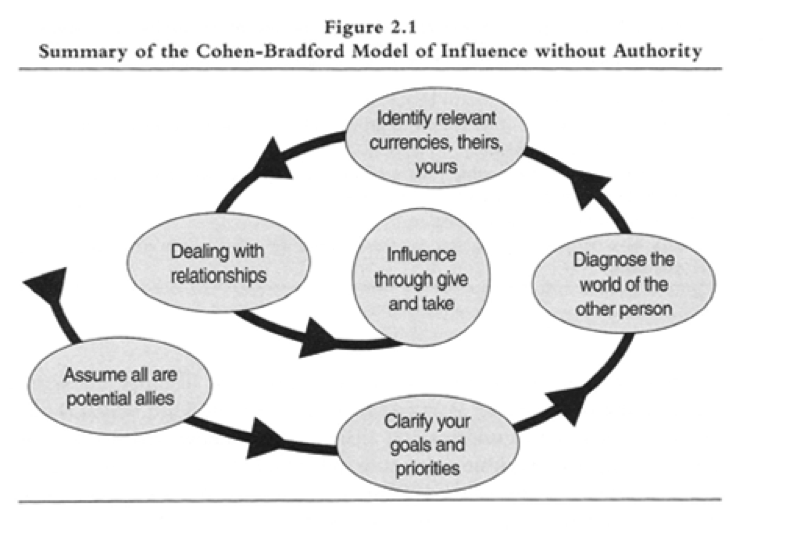
In the first of this series of articles on collaboration, I explored the idea that the first part of moving from unhealthy conflict to collaboration is to take charge of your own threat – anxiety – defence response. In this blog I will explore the second part, which is to use a collaborative model to prepare for the discussion. I will use the Cohen-Bradford Model of Influence Without Authority.
Cohen-Bradford Model of Influence without Authority, leadership, collaboration, influence
Assume Everyone is a Potential Ally
This is a model that guides your preparation for the collaboration – and preparation is essential. In this model, the starting point is with your assumptions: Assume everyone involved is a potential ally and WANTS to solve the problem. If you assume the opposite, you will be right and you will be on a hiding to nothing.


Goals and Priorities
The next step is to clarify your goals and priorities:
  1. What are your business goals?
  2. How does the current situation make it difficult/impossible to achieve these goals?
  3. What problems need to be solved with your colleagues?
  4. What is the priority order of those problems?
  5. What do you want to achieve in your collaboration with your colleagues?

Do this in writing. If a group of you is going to engage with colleagues in another department, do this preparation together.

Understand Their World
Now you need to think about the world of your colleagues. What are they experiencing as survival threats? What are they trying to achieve? What is keeping them up at night? What do they experience every time they deal with you or your team? Get into their shoes. Sit in their chair. This is an essential part of your preparation, and will help you to keep the discussion positive and forward-focused. Remember that all behaviour is completely logical to the person behaving – so get into their heads so that you can understand their intentions or concerns.

What Do You Have to Exchange
The fourth part of your preparation is to identify currencies – the things you can trade in order to get what you want. These are the things that are important to you and the things that are important to your colleagues. For example, your currency might be competitive Repairs and Maintenance Contracts and turnaround times of less than 8 hours. Their currency might be detailed information and a 12 hour turnaround time. Once again, it is important to make the effort to get into the heads of your colleagues. You can only understand what they value if you get into their heads. There is no need for conflict if you have already thought these things through and can already offer what your colleagues want.


Focus on Relationships
The fifth part of your preparation is to remember that everything is achieved through relationships. If you value the relationship and put it front and centre, and you remember that you catch more flies with honey than you do with vinegar, this will take you a long way.

Influence Through Give and Take
Finally, once you are in the discussion, you will influence through give and take – this is an exchange of your respective currencies. Go into the discussion clear on what you are prepared to give – and err on the side of generosity because it will make the discussion go so much more smoothly.

​Contact me
If you are a leader/manager and this topic is something you would like to develop in yourself, email me at [email protected] and let's discuss your coaching programme.
0 Comments
<<Previous
Forward>>

    Categories

    All
    20Plenty
    Accountability & Responsibility
    Adaptability
    Authentic Conversations
    Belinda Davies
    Celebrate Success
    Change
    Coach
    Coaching
    #coaching
    Conversation
    CPD (Continuing Professional Development)
    Culture
    Culture Change
    Decision Quality
    Diversity
    Emotional Regulation
    Empathy
    Empathy Is Not Intuition
    Employeeengagement
    Employee Engagement
    Employee Survey
    Endurance
    Engagement
    Ethics & Ethical Dilemmas
    Focus
    #goals
    Gratitude
    Grit
    Health
    Influence
    Inspiration
    Inspirational Leadership
    Inspiring Others
    Leaders As Coaches
    Leadership
    #leadership
    Leadership Development
    Leadership Skills
    Leadership Solutions
    Life Is Difficult
    Management
    #management
    Managers
    Managers As Coaches
    Managers-as-coaches
    Mental Health
    Mental Toughness
    Motivation
    New Beginnings
    Optimism
    People Who Thrive
    Performance
    Performance Under Pressure
    Personal Leadership
    Planning
    Professional Supervision
    Reinvent Yourself
    Relationships
    Relationships Matter
    Resilience
    Rules Of Engagement
    Self-acceptance
    Self Awareness
    Self-awareness
    Self Care
    Self Leadership
    Self-Leadership
    Self-love
    Self Mastery
    Self-mastery
    Self-worth
    Servant Leadership
    Staying The Course
    Strategic Leadership
    #success
    Team_resilience
    Teams
    The Discipline Of Leadership
    Thrive
    Trust & Trustworthiness
    Values
    Victimhood
    Victim Mentality
    Victim Mindset
    Vision
    Winning Mindset

    Archives

    March 2024
    February 2024
    July 2022
    June 2022
    May 2022
    April 2022
    March 2022
    February 2022
    January 2022
    December 2021
    November 2021
    October 2021
    September 2021
    August 2021
    May 2021
    April 2021
    March 2021
    February 2021
    January 2021
    November 2020
    October 2020
    September 2020
    August 2020
    July 2020
    June 2020
    May 2020
    April 2020
    March 2020
    February 2020
    January 2020
    October 2019
    September 2019
    May 2019
    March 2019
    January 2019
    February 2018
    April 2017
    December 2015
    November 2015
    October 2015
    September 2015
    August 2015
    July 2015
    May 2015

    RSS Feed

Whats Next?

Leadership Development
Executive Coaching
Business Strategy

What my clients say

Articles
    Work We've Done
    Self-leadership
    Strategic Leadership
    Strategic Thinking
    Strategy

Call me! 082 5519504
Picture
Picture
Picture

    What improvements or changes do you seek?

Submit