
You can also connect with us on:
Leadership Solutions: Executive Coaching and Leadership Development specializing in Strategy Development and Implementation
  • Home
  • About
  • Coaching
    • Coaching Offer!
    • How I work and why you should work with me
    • The Benefits of Coaching
    • Effective Teams
    • Executive Coaching
    • Coaching and Mentoring: Developing Managers as Coaches & Mentors
    • Difficult Team Conversations
    • Choosing a Coach
  • Strategy
    • What is Strategy? >
      • What it takes to make a good Strategy
      • Diagnosing the internal environment
      • Figuring Out How to Reach the Promised Land
      • Strategy: External Analysis
      • The Competitive Environment
      • Defining the Challenge and Creating the Guiding Policy
      • WIGs, Scoreboards and Tracking Progress
    • Strategic Leadership >
      • Strategic Thinking
      • Strategic Thinking (cont.)
      • Strategic Acting
      • Strategic Acting (cont.)
      • Strategic Acting (cont.)
      • Strategic Influencing
      • Strategic Influencing (cont.)
      • Strategic Influencing (cont.)
      • Strategic Leadership Teams
      • Strategy as a Learnining Process
      • Summing Up Strategic Leadership
    • Strategic Thinking >
      • What is Strategic Thinking?
      • Strategic Thinking as a Discipline
      • Where to Play and How to Win
      • Bucking an Industry Norm
      • Replicating Pockets of Excellence
      • Questions about Strategic Thinking
  • Leadership
    • Developing Business Leaders
    • Personality and Business
    • Self-Leadership >
      • Selling when you are not a Sales Person
      • Meetings! Bloody Meetings! Be Mindful
      • Resilience. How Resilient are You?
      • Resilience: Build your Own
      • Build Your Team's Resilience
    • Leadership >
      • #UselessLosers
      • Leadership is Exercised One Conversation at a Time
      • Presenteeism - Doing more harm than good
      • 5 Steps to Develop your Leadership Skills
    • Culture Change
  • Clients
    • What Our Clients Say >
      • What a Massive Shift
      • Our small part in the fight against Corruption
  • Articles
  • Contact

Gratitude and the Brain

11/4/2021

0 Comments


Picture


​If you want to listen to the audio of this article, see above!


Serendipity is a funny thing! The other evening I was chatting to my stepson’s girlfriend. She is one of those unlucky people who is tormented by anxiety – and I work with A LOT of people who struggle with anxiety. Not only are some personalities “anxious types”, but we live in a world that exacerbates any predispositions we may have,
I was sharing with her some guidelines for dealing with her anxiety. The fact of the matter is that those who struggle with anxiety must accept that managing it is a lifelong commitment. However, it can be done with the development of some essential skills (this is NOT instead of medication).
​
Gratitude Reduces Anxiety
The next morning I went to check what my social media topic is for November – GRATITUDE. So I started doing some reading to get some ideas for the articles for the month. It turns out that practicing gratitude has beneficial effects on all sorts of things, one of which is … Anxiety!
I can’t remember why I chose Gratitude as the topic for November – although it is the month when Americans celebrate Thanksgiving, so perhaps that had something to do with it. Nevertheless, we are heading downhill to the end of the year at a dizzying rate, and most people are feeling somewhat frazzled.

It Keeps You Focused on the Positive
At a time like this, it is easy to focus on one’s frayed edges – but that only adds to the sense of exhaustion. Shifting your focus to matters of gratitude is remarkably helpful and will add to your resilience at a time when we all need it.
How does gratitude work? While the practice of gratitude is a topic for a later newsletter, it is worthwhile noticing that all forms of the practice require that one articulates what one is grateful for. This means that you are naming what you appreciate and why – you are putting it into words. It doesn’t matter if it is something you are grateful for from or about another person, or if it is something you are grateful for in your life. What matters is that you are putting it into words. This says something about the power of words!

Gratitude is Good for Your Brain
Articulating what you are grateful for does several things, all of which are positive:
  1. It moves your attention away from negative emotions and distracts you from ruminating about the negative experiences in your life.
  2. Over time and with disciplined practice, gratitude shifts your focus to what is positive in your life and changes the overall tone of your internal world. “It is not happiness that brings us gratitude. It is gratitude that brings us happiness.” (Madhuleena Roy Chowdhury, 2021). It is this shift in focus that rewires the brain from an anxious, apprehensive one to a calm and grateful brain.
  3. It positively impacts your brain! People who practice and express gratitude show more activity in the part of the brain associated with learning and decision-making (the medial prefrontal cortex) than those who don’t – which represents a general enhancement of brain function.
  4. Gratitude is a natural antidepressant. Whether we express gratitude or receive it, it causes a release of oxytocin and serotonin in the brain – the feel-good neurotransmitters that enhance one’s feelings of happiness and well-being.
  5. Gratitude is good for your health. Research conducted in the field of positive psychology has reliably demonstrated that keeping a gratitude journal improves the quality of sleep, reduces stress, and enhances energy and vitality.
  6. Gratitude has a positive impact on professional commitment – in both the person expressing gratitude and in the person receiving it – and this enhances the quality of work performance and team work. Employees who express gratitude are more likely to put their hands up for extra work, and managers who express gratitude build stronger teams and enjoy greater productivity. They are also well liked! Let’s not underestimate the value of being well liked in being able to get things done and pull rabbits out of hats when you need to.
  7. The practice of gratitude fortifies your resilience – which is what helps you to bounce back more quickly after setbacks and tough experiences.

Write it Down
As you brace yourself for the final push in 2021, think about the following (and write it down):
  • What are you grateful for in your life?
  • To whom are you grateful and for what?
  • Who in your world deserves some appreciation? How will you express this?
To read a little more about the impact of gratitude on your brain, go here and here.

Look out for next week’s article on Gratitude Practices.

Contact Me
If you would like to work on your own resilience as a leader, email me on [email protected] and let’s discuss your coaching programme.

0 Comments

When Life if Difficult Self-care is Key

3/2/2020

0 Comments

 
Picture
In the inimitable words of M. Scott Peck:
"Life is difficult.
This is a great truth. One of the greatest truths. It is a great truth because once we truly see this truth, we transcend it. Once we truly know that life is difficult - once we truly know and accept it - then life is no longer difficult. Because once it is accepted, the fact that life is difficult no longer matters." (From The Road Less Travelled).

The world over, life is difficult. What tends to vary is the source of the difficulty. It may be the economy. It may be health. It may be family issues. It could be the internal politics of your company. There are as many sources of difficulty as there are people. 

In my coaching practice, my clients are dealing with the following sources of difficulty:
  • declining markets;
  • disruption to the normal flow of things because of the corona virus causing delays in manufacturing, imports and deliveries as well as disrupting access to overseas markets;
  • headcount freezes because of real or anticipated economic slow down resulting in having to do more with less;
  • having to shave margins to the bone just to compete (which I've heard called "the race to zero margin");
  • toxic workplaces where people are constantly on edge, where bullying is rife, and where people always feel like they have to watch their backs;
  • pressure from overseas holding companies because they have problems (even if your local operation is flying);
  • rolling out new initiatives and piloting new business models under global scrutiny;
  • having to manage teams that feel overwhelmed, undervalued, and fed up while trying to inspire excitement about some vision that currently feels like a pipe dream.

And that was just last week!

Almost inevitably, when life is difficult, we focus all our energy and attention on managing that difficulty. As a consequence, we start doing things that actually make things more difficult for both ourselves and those around us. Let's consider some examples:
  • we spend more and more time in meetings that are not productive and are less available to our people;
  • we work longer hours in order to meet tighter deadlines;
  • we stop taking lunch breaks;
  • we eat more junk and eat for comfort more often;
  • we sacrifice exercise because we are too busy;
  • we zone out on social media more often because we are too exhausted to actually engage with our spouse or children;
  • we use booze to relax and pills to get to sleep;
  • we rush from meeting to meeting, walking too fast and looking too intense or stern and talking too fast and listening too little;
  • we carry with us a pervasive anxiety that just sits in the pit of our stomach creating this feeling of impending doom;
  • we obsess on the bad news that is all around us which only adds to our sense of impending doom.

Sound familiar? Did I just make your day even more difficult?

These behaviours are how we respond to the difficulties that are part of life when we have not made peace with the idea that life is difficult - and what we are dealing with today just happens to be the present source of difficulty. And, as with all things, this too shall pass. And then things will be less difficult, and then things will get difficult again. 

The point I am making is that the difficulty you are experiencing now is part of how life works. It may feel unusual or special in some way, but it isn't really. And the sacrifices that we make in terms of self-care and care for others does not help us through the current difficulty - it actually makes things worse. When we sacrifice self-care we ensure that it is our lower selves that we are pitched at our difficulties, when the situation really requires the highest version of ourselves. When we sacrifice self-care we communicate to others that this is what is expected and what is required - with the result that those around us also bring their lower selves. The characteristics of our lower selves include:
  • impatience;
  • anxiety;
  • short-tempers;
  • fear-based thinking (which is thinking of a far lower quality than the thinking that happens when we are calm) resulting in fear-based decisions.

When life is difficult it feels right that we should be pushing the hours, working harder, taking less time for ourselves and others - it feels like this is what we need to do to get over the hump. But trust me. This hump will be replaced by another hump, and then another one. So what do we have to do?

1. Accept that your current difficulty is your normal for now. It is what it is. It's not special. It's not unusual. It just is. Ask yourself this question: if you knew that this situation was what you have to look forward to for the rest of your life would you carry on the way you are? Or might you think "The hell with it! I might as well take care of myself!"
2. Get some perspective. Get off the playing field and up onto the balcony and take a look at what is going on on the field. Do this with someone you trust who is not on the field too - a coach, a mentor, a friend who you know will help you gain some perspective. Gaining perspective is about:
  • creating some distance between you and the current difficulty;
  • getting clear on priorities;
  • working out a game plan to address the priorities; 
  • deciding what not to focus on for now.
3.  Put some essential disciplines in place:
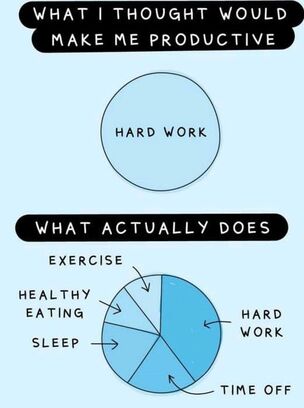
  • exercise time;
  • eat away from your desk;
  • eat good calories. Your brain is an energy gobbling machine. Don't feed it garbage. Garbage in, garbage out;
  • set limits on your working hours and boundaries between work and home. For example, eat breakfast and dinner at the table with your family and without devices; work longer at the office if you must but then don't work at home; or do an hour of work before the family is awake and then have breakfast with the family;
  • sleep: know yourself. If you are an 8 hour per day person, then that is what you need. Sleep is essential to your productivity and effectiveness;
  • block out time for your people. Life is difficult. They need access to you;
  • take time out. Find a relaxation practice that suits you: a walk in nature; a mindfulness meditation; listening to flowing water; something that will slow down your racing mind;
4. Make a To Don't list. When life is difficult, we have to decide what we are going to put down. 
  • What meetings should you not go to? What meetings just shouldn't take place at all? Would everyone's life be easier if there was a Friday ban on meetings? Should meetings be limited to 40 minutes? Should you have your meetings standing up?
  • What responsibilities should you delegate or just put down for now?
  • What tasks or responsibilities need to be executed in a leaner, simpler, less engineered way?
  • During which times of the day will you not be available to take calls?
  • Is there anything else you need to NOT do because it adds little value and is making life more difficult? Is there anything your team should NOT do for the same reasons?
5. Slow down! Walk more slowly. Talk more slowly. Listen more attentively. Don't make fear-based, knee-jerk decisions. They create as many new fires as you think you're putting out. Fear-based behaviour on the part of a leader creates panic and anxiety. Your job, when life is difficult, is to create calm.
  • Practice asking more questions. When life is difficult the quality of your thinking is paramount. You don't have to have an instant answer. You have to have a quality answer. Ask questions until you have looked at the issue from every angle. Then make your  decision. 
  • If at all possible, sleep on your decisions. This will slow things down a bit, and will also allow your subconscious to apply itself to the issue and make sense of things in a way your conscious mind does not. Identify what decisions must NOT be made until you are sure they will result in quality actions.
6. Find moments where you can have fun. Play with your children for half an hour. Go on a date. Play a silly board game. Laugh! The release of endorphins when you laugh counters stress hormones and improves immunity, as well as contributing to an overall sense of well-being.​

​7. Make time for your faith practices, if you are a person of faith. Knowing you are not alone is hugely positive for your sense that you can get through whatever difficulties you are dealing with. 

When life is difficult, self-care is key. The tactics I've described are all about taking care of yourself - and many of them will also take care of your people. When your people are struggling with the same difficulties that you are, or some of their own, these tactics will help to build their resilience. Self-care is absolutely vital to building resilience - in yourself and in others - and resilience is what gets us through the tough times.

When life is difficult, our default is to dive into action. Most of these tactics are counter intuitive, so you won't trust that implementing them all at once will do anything except create more problems. So start with one thing first. My own recommendation is that you start with some form of relaxation practice or exercise regime - but it's horses for courses really. Just start with one form of self-care. Then as you see that it actually helps, you could add another and another. And remember to care for your team as you care for yourself. They share your difficulties even when yours are personal.
​

Picture
0 Comments

    Categories

    All
    20Plenty
    Accountability & Responsibility
    Adaptability
    Authentic Conversations
    Belinda Davies
    Celebrate Success
    Change
    Coach
    Coaching
    #coaching
    Conversation
    CPD (Continuing Professional Development)
    Culture
    Culture Change
    Decision Quality
    Diversity
    Emotional Regulation
    Empathy
    Empathy Is Not Intuition
    Employeeengagement
    Employee Engagement
    Employee Survey
    Endurance
    Engagement
    Ethics & Ethical Dilemmas
    Focus
    #goals
    Gratitude
    Grit
    Health
    Influence
    Inspiration
    Inspirational Leadership
    Inspiring Others
    Leaders As Coaches
    Leadership
    #leadership
    Leadership Development
    Leadership Skills
    Leadership Solutions
    Life Is Difficult
    Management
    #management
    Managers
    Managers As Coaches
    Managers-as-coaches
    Mental Health
    Mental Toughness
    Motivation
    New Beginnings
    Optimism
    People Who Thrive
    Performance
    Performance Under Pressure
    Personal Leadership
    Planning
    Professional Supervision
    Reinvent Yourself
    Relationships
    Relationships Matter
    Resilience
    Rules Of Engagement
    Self-acceptance
    Self Awareness
    Self-awareness
    Self Care
    Self Leadership
    Self-Leadership
    Self-love
    Self Mastery
    Self-mastery
    Self-worth
    Servant Leadership
    Staying The Course
    Strategic Leadership
    #success
    Team_resilience
    Teams
    The Discipline Of Leadership
    Thrive
    Trust & Trustworthiness
    Values
    Victimhood
    Victim Mentality
    Victim Mindset
    Vision
    Winning Mindset

    Archives

    March 2024
    February 2024
    July 2022
    June 2022
    May 2022
    April 2022
    March 2022
    February 2022
    January 2022
    December 2021
    November 2021
    October 2021
    September 2021
    August 2021
    May 2021
    April 2021
    March 2021
    February 2021
    January 2021
    November 2020
    October 2020
    September 2020
    August 2020
    July 2020
    June 2020
    May 2020
    April 2020
    March 2020
    February 2020
    January 2020
    October 2019
    September 2019
    May 2019
    March 2019
    January 2019
    February 2018
    April 2017
    December 2015
    November 2015
    October 2015
    September 2015
    August 2015
    July 2015
    May 2015

    RSS Feed

Whats Next?

Leadership Development
Executive Coaching
Business Strategy

What my clients say

Articles
    Work We've Done
    Self-leadership
    Strategic Leadership
    Strategic Thinking
    Strategy

Call me! 082 5519504
Picture
Picture
Picture

    What improvements or changes do you seek?

Submit