
You can also connect with us on:
Leadership Solutions: Executive Coaching and Leadership Development specializing in Strategy Development and Implementation
  • Home
  • About
  • Coaching
    • Coaching Offer!
    • How I work and why you should work with me
    • The Benefits of Coaching
    • Effective Teams
    • Executive Coaching
    • Coaching and Mentoring: Developing Managers as Coaches & Mentors
    • Difficult Team Conversations
    • Choosing a Coach
  • Strategy
    • What is Strategy? >
      • What it takes to make a good Strategy
      • Diagnosing the internal environment
      • Figuring Out How to Reach the Promised Land
      • Strategy: External Analysis
      • The Competitive Environment
      • Defining the Challenge and Creating the Guiding Policy
      • WIGs, Scoreboards and Tracking Progress
    • Strategic Leadership >
      • Strategic Thinking
      • Strategic Thinking (cont.)
      • Strategic Acting
      • Strategic Acting (cont.)
      • Strategic Acting (cont.)
      • Strategic Influencing
      • Strategic Influencing (cont.)
      • Strategic Influencing (cont.)
      • Strategic Leadership Teams
      • Strategy as a Learnining Process
      • Summing Up Strategic Leadership
    • Strategic Thinking >
      • What is Strategic Thinking?
      • Strategic Thinking as a Discipline
      • Where to Play and How to Win
      • Bucking an Industry Norm
      • Replicating Pockets of Excellence
      • Questions about Strategic Thinking
  • Leadership
    • Developing Business Leaders
    • Personality and Business
    • Self-Leadership >
      • Selling when you are not a Sales Person
      • Meetings! Bloody Meetings! Be Mindful
      • Resilience. How Resilient are You?
      • Resilience: Build your Own
      • Build Your Team's Resilience
    • Leadership >
      • #UselessLosers
      • Leadership is Exercised One Conversation at a Time
      • Presenteeism - Doing more harm than good
      • 5 Steps to Develop your Leadership Skills
    • Culture Change
  • Clients
    • What Our Clients Say >
      • What a Massive Shift
      • Our small part in the fight against Corruption
  • Articles
  • Contact

Resilience, Grit and Mental Toughness: Nature or Nurture?

3/26/2024

0 Comments

 
Image by <a href=Digib from Pixabay" style="width:auto;max-width:100%" />
Over the last while I’ve been reading and writing about resilience, grit and mental toughness simply because I believe that life is difficult – it is difficult for all of us in different ways at different times – and if we don’t develop those capacities that enable us to endure, then we will live a life of suffering.
Resilience, grit, and mental toughness are interconnected psychological constructs that relate to how individuals cope with and adapt to challenges, setbacks, and stressors. While they share some similarities, they also have distinct characteristics:
Resilience refers to an individual's ability to bounce back from adversity, trauma, or stress. It involves adapting positively in the face of adversity, maintaining psychological well-being, and often growing stronger as a result of challenges.
Grit is defined as perseverance and passion for long-term goals. It involves sustaining effort and interest in pursuing objectives despite setbacks, failures, or obstacles.
Mental toughness is characterized by the ability to maintain focus, determination, and motivation in the midst of pressure, stress, or difficult situations. It involves staying composed, resilient, and performing effectively under pressure.
 
I have explored 2 questions in this article:
  1. Does having had a tough and wounding childhood enhance the likelihood of your having these capacities or diminish it? In other words, are they a consequence of nurture or life experiences? And secondly,
  2. How does personality type influence the extent to which you have or do not have these capacities? Is it more to do with nature?
The answers are really interesting – but not entirely surprising.

Childhood psychological wounds can significantly impact an individual's resilience, grit, and mental toughness – and it can be either positive or negative:
Positive Impact: Some people develop resilience, grit, and mental toughness as a result of overcoming childhood adversity or trauma. In some people, these experiences can lead to increased self-awareness, coping skills, and a deeper understanding of one's strengths and limitations.
Negative Impact: On the other hand, childhood psychological wounds can also hinder the development of resilience, grit, and mental toughness. People who experienced significant childhood trauma, neglect, or adversity may struggle with trust issues, low self-esteem, difficulty regulating their emotions, and difficulty coping with the stresses of life.
The impact of negative childhood experiences on resilience, grit, and mental toughness can vary widely among different people and there is no direct predictable causal link. Factors such as social support, coping mechanisms, access to resources, and personal beliefs play crucial roles in shaping one’s ability to thrive despite past challenges.
In summary, while personality traits can influence the level of resilience, grit, and mental toughness individuals exhibit, experiences and childhood psychological wounds also play significant roles. Positive experiences can foster growth and resilience, while negative experiences may pose challenges that require intentional effort and support to overcome.

In my coaching practice I use the Enneagram profile quite a lot, so I was curious about the impact of personality on one’s resilience, grit and mental toughness. The Enneagram is a personality typing system that categorizes people into nine distinct personality types, each with its own motivations, fears, strengths, and growth areas. While the Enneagram primarily focuses on underlying motivations and core beliefs rather than specific traits like resilience, grit, and mental toughness, certain Enneagram types may exhibit characteristics that align with these qualities to varying degrees. It's important to note that individuals of any Enneagram type can develop resilience, grit, and mental toughness through self-awareness, personal growth, and intentional efforts.

Here's a general overview of how different Enneagram types might relate to resilience, grit, and mental toughness:
Type 1 - The Perfectionist: Ones are often driven by a desire for integrity, improvement, and doing what is right. They can exhibit high levels of resilience and mental toughness, particularly in areas where they are committed to making a positive impact or upholding their principles. However, their perfectionistic tendencies may also create pressure and self-criticism that could affect their grit in some situations.
Type 2 - The Helper: Twos are empathetic, caring, and supportive people who often prioritize the needs of others. They may demonstrate resilience and grit in relationships and situations where they can contribute to others' well-being. However, they may need to cultivate mental toughness in setting boundaries and prioritizing self-care.
Type 3 - The Achiever: Threes are ambitious, goal-oriented, and focused on success. They can display high levels of grit and mental toughness in pursuing their objectives and overcoming obstacles to achieve recognition and accomplishment. However, they may need to develop resilience in handling setbacks or failures that challenge their self-image.
Type 4 - The Individualist: Fours are introspective, creative, and sensitive people who value authenticity and emotional depth. They may demonstrate resilience in navigating complex emotions and experiences, drawing strength from their introspection and self-expression. However, they may face challenges in developing grit and mental toughness in areas requiring sustained effort and practicality.
Type 5 - The Investigator: Fives are analytical, knowledgeable, and independent thinkers who seek understanding and expertise. They may exhibit resilience and mental toughness in intellectual pursuits and problem-solving, leveraging their capacity for deep focus and strategic thinking. However, they may need to work on grit in interpersonal or high-pressure situations that demand emotional engagement.
Type 6 - The Loyalist: Sixes are loyal, responsible, and cautious people who value security and preparedness. They can demonstrate resilience and mental toughness in situations where they feel supported, trusted, and prepared for challenges. However, their anxiety and fear of uncertainty may sometimes impact their grit, requiring them to build confidence and assertiveness.
Type 7 - The Enthusiast: Sevens are adventurous, optimistic, and spontaneous people who seek new experiences and possibilities. They may display resilience in bouncing back from setbacks and maintaining a positive outlook, drawing on their adaptability and optimism. However, they may need to develop grit in sticking with long-term commitments and facing uncomfortable emotions.
Type 8 - The Challenger: Eights are assertive, decisive, and protective people who value strength, autonomy, and fairness. They often exhibit high levels of resilience, grit, and mental toughness in facing challenges, standing up for themselves and others, and driving change. However, they may benefit from cultivating emotional resilience and vulnerability in certain situations.
Type 9 - The Peacemaker: Nines are peaceful, harmonious, and accommodating people who seek unity and avoid conflict. They may demonstrate resilience in maintaining stability and calmness under pressure, leveraging their adaptability and empathy. However, they may need to develop grit in asserting their needs and priorities, as well as maintaining focus on personal goals.
​
It's essential to remember that Enneagram types provide insights into core motivations and patterns of behaviour. It does not determine an individual's capacity for resilience, grit, or mental toughness, although it may suggest how this might vary within an individual.
 
The key to personal growth of any kind is self-awareness, introspection, and personal efforts. Regardless of your childhood experiences or your personality type, you can develop all of these capabilities.
0 Comments

Building Mental Toughness: Strategies for Resilience and Growth

3/12/2024

0 Comments

 
Picture
alora-griffiths-WiKEnlt6Z3U-unsplash
​In the journey toward mental toughness, mere aspiration is not enough; it requires deliberate action, consistent practice, and unwavering commitment. While some may be naturally predisposed to resilience, the truth is that mental toughness is a skill that can be cultivated and honed through a series of exercises, habits, and disciplines. In this follow-up article, we'll explore practical strategies that can empower individuals to develop the fortitude and resilience needed to thrive in the face of adversity.
  1. Embrace discomfort: One of the surest paths to mental toughness is to intentionally seek out discomfort and challenge. Whether it's pushing yourself to exercise beyond your comfort zone, tackling a difficult project at work, or engaging in activities that stretch your mental limits, embracing discomfort is key to building resilience. Start small and gradually increase the intensity of your challenges, allowing yourself to adapt and grow stronger with each step.
  2. Cultivate a growth mindset: Adopting a growth mindset, as coined by psychologist Carol Dweck, is essential for developing mental toughness. Instead of viewing challenges as insurmountable obstacles, see them as opportunities for growth and learning. Embrace failure as a natural part of the learning process and use setbacks as stepping stones toward success. By reframing your mindset, you'll develop the resilience needed to bounce back from adversity stronger than ever before.
  3. Practice mindfulness and emotional regulation: Cultivating mindfulness through practices such as meditation, deep breathing exercises, or journaling can help strengthen emotional regulation – a cornerstone of mental toughness. By learning to observe your thoughts and emotions without judgment, you'll develop greater self-awareness and control over your reactions. In moments of stress or pressure, mindfulness can serve as an anchor, enabling you to maintain composure and make clear-headed decisions.
  4. Set challenging but achievable goals: Goal-setting is a powerful tool for fostering resilience and motivation. Set specific, measurable, and challenging goals that push you outside your comfort zone, yet are achievable with effort and dedication. Break larger goals down into smaller, actionable steps, and celebrate your progress along the way. By setting and achieving goals, you'll build confidence in your ability to overcome obstacles and stay the course, even when the going gets tough.
  5. Build a support network: Surround yourself with individuals who inspire and uplift you, and who share your commitment to growth and resilience. Cultivate relationships with mentors, coaches, or peers who can provide guidance, support, and encouragement during challenging times. Having a strong support network not only provides emotional reinforcement but also fosters accountability and camaraderie on your journey toward mental toughness.
  6. Develop mental imagery and visualization techniques: Harness the power of mental imagery and visualization to enhance your performance under pressure. Take time each day to visualize yourself succeeding in your endeavors, whether it's delivering a flawless presentation, conquering a personal goal, or overcoming a daunting challenge. By vividly imagining success, you'll prime your mind and body to perform at their best when faced with real-world challenges.
  7. Practice resilience-building exercises: Engage in activities that intentionally challenge your resilience and perseverance. This could involve setting aside time each day to tackle a difficult puzzle or problem, pushing yourself to complete a physically demanding workout, or confronting fears and uncertainties head-on. By deliberately exposing yourself to adversity in controlled settings, you'll develop the mental fortitude needed to thrive in uncharted territory.
  8. Cultivate self-care habits: Finally, prioritize self-care as a fundamental component of mental toughness. Ensure you're getting enough sleep, maintaining a healthy diet, exercising regularly, and carving out time for relaxation and rejuvenation. Self-care not only replenishes your physical and emotional reserves but also strengthens your resilience in the face of stress and adversity.

In conclusion, building mental toughness is a journey that requires dedication, perseverance, and a willingness to embrace discomfort. By incorporating these exercises and habits into your daily routine, you'll cultivate the resilience and fortitude needed to thrive in today's unpredictable world. Remember, mental toughness is not just about enduring hardship; it's about embracing challenges as opportunities for growth and emerging stronger on the other side. So, as you embark on this journey toward greater resilience, stay committed, stay focused, and stay resilient – the rewards are well worth the effort.
0 Comments

The Art of Mental Toughness: A Blueprint for Resilience and Success

3/12/2024

0 Comments

 
​In the high-stakes arena of modern life, where challenges lurk around every corner and uncertainties abound, mental toughness stands as the bedrock upon which success is built. It's not merely a trait; it's a strategic advantage, a shield against the onslaught of adversity, and a guiding light in the darkest of times. From the boardroom to the playing field, those who possess mental toughness are not just survivors; they're victors. But what exactly is mental toughness, and why is it indispensable in today's fast-paced world?
At its core, mental toughness is the epitome of resilience. It's the unwavering ability to bounce back from setbacks, failures, and disappointments, emerging stronger and more determined than ever before. In a landscape where the only constant is change, resilience becomes the cornerstone of enduring success. It's the difference between succumbing to pressure and rising above it, between faltering at the first sign of trouble and pressing forward with unwavering resolve.
But mental toughness is more than just bouncing back; it's about forging ahead with self-confidence in the face of uncertainty. It's the unshakable belief in one's abilities, even when the odds seem insurmountable. With self-confidence as its cornerstone, mental toughness empowers individuals to navigate the choppy waters of life with poise and purpose, never losing sight of their goals despite the storm raging around them.
Crucial to the fabric of mental toughness is emotional regulation – the ability to maintain composure and clarity of thought, even in the most trying of circumstances. In a world where pressure is omnipresent and stressors lurk at every turn, emotional regulation becomes the linchpin of success. It's the difference between succumbing to panic and making sound, rational decisions under fire. By mastering their emotions, individuals with mental toughness are able to keep their eyes on the prize, regardless of the chaos unfolding around them.

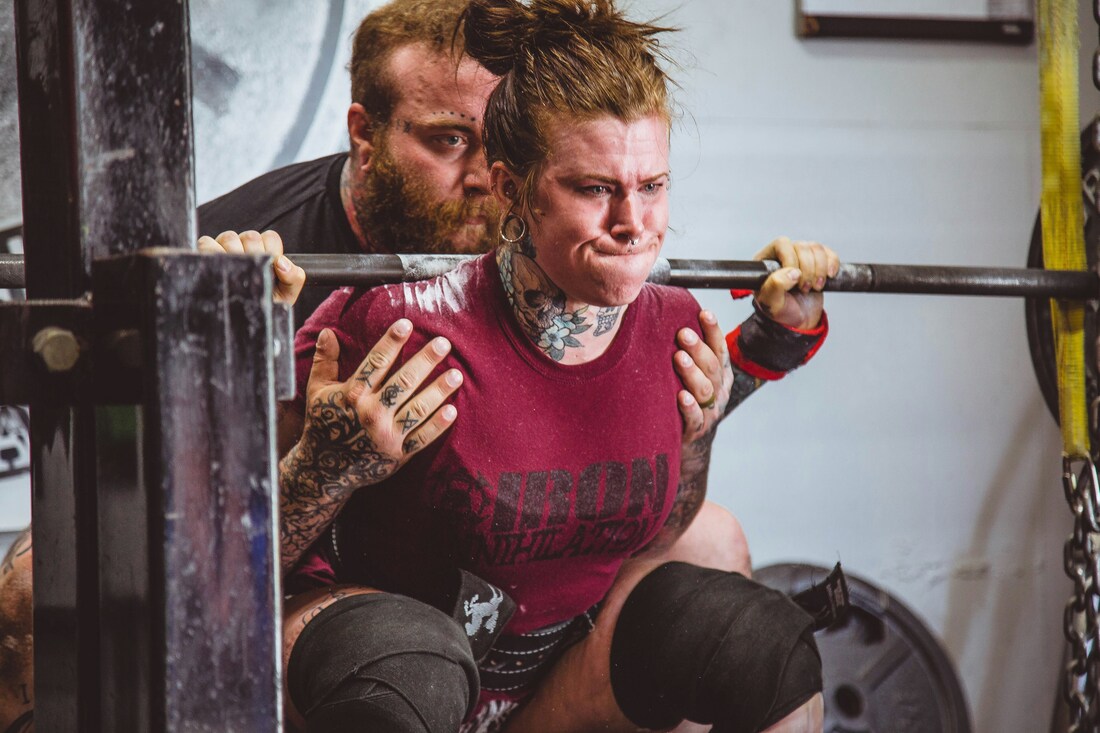
Picture
quino-al-txDt77eRGrM-unsplash
​Performance under pressure is where mental toughness truly shines. Whether it's on the field of play or in the boardroom, the ability to deliver when the stakes are highest can be the difference between victory and defeat. Those with mental toughness thrive under pressure, using it as fuel to propel themselves to new heights of achievement. With a laser-like focus and an uncanny ability to tune out noise and distractions, they remain steadfast in their pursuit of excellence, undeterred by the challenges that lie in their path.
Moreover, mental toughness has a profound impact on the quality of decisions made under duress. In moments of crisis, when split-second judgments can make or break a situation, clarity of thought becomes paramount. By cultivating mental toughness, individuals sharpen their cognitive faculties, enabling them to make well-informed decisions under even the most harrowing circumstances. In this way, mental toughness not only ensures survival but also paves the way for triumph in the face of adversity.
But perhaps most importantly, mental toughness is the bedrock upon which self-worth and self-confidence are built. In a world that often seeks to undermine our sense of value and purpose, mental toughness serves as a bulwark against self-doubt and insecurity. By cultivating a deep reservoir of inner strength and fortitude, individuals with mental toughness bolster their self-confidence and reaffirm their self-worth, regardless of the challenges they encounter along the way.
Endurance, both physical and mental, is the hallmark of mental toughness. It's the ability to stay the course when others falter, to persevere when the journey seems endless, and to emerge victorious against all odds. In a world that prizes instant gratification and quick fixes, mental toughness reminds us that true success is a marathon, not a sprint. It's about embracing the long and winding road, knowing that each step brings us closer to our ultimate destination.
In conclusion, mental toughness is not just a trait; it's a way of life. It's about embracing challenges, confronting adversity, and emerging stronger on the other side. With resilience as its cornerstone, self-confidence as its guiding light, and emotional regulation as its compass, mental toughness empowers individuals to thrive in the face of uncertainty. By honing their ability to perform under pressure, tune out distractions, and make sound decisions, they chart a course toward success that is as unwavering as it is unstoppable. So, as you navigate the turbulent waters of life, remember this: the path to success is not for the faint of heart, but for those who possess the indomitable spirit of mental toughness.
0 Comments

Grit: Exercises and Disciplines for Developing Grit

2/12/2024

0 Comments

 
Let's start with a reminder of what we understand Grit to be:
  • It is a  specific kind of resilience that you find in certain people who display “passion and sustained persistence applied toward long-term achievement, with no particular concern for rewards or recognition along the way.” 
  • It seems to combine the application of resilience, ambition and self-discipline to goals whose achievement may take years and even decades.
  • The acronym GRIT refers to Guts, Resilience, Initiative and Tenacity.
PicturePhoto by <a href=NEOM on Unsplash " class="galleryImageBorder wsite-image" />
​There seems to be a strong connection between Grit and a growth mindset - seeing achievement as being the result of the acquisition of skill over time, and commitment to continuous improvement.(For more about the definition of Grit, see www.leadershipsolutions.co.za/articles/grit-sticking-with-it-for-the-long-haul).

1. Set Challenging Long-term Goals - the starting point

Since the essence of Grit is that one is able to persist towards BIG long-term goals, that is the place to start.

What is the big, long-term goal that you want to achieve? It is likely to be something that will take several years to achieve. Perhaps there is a 5 - 10 year business goal; or a long-term goal in terms of a qualification you want to achieve; or a challenging financial goal that you are after. 

Put this goal down on paper. Build as much detail into what the successful achievement of the goal will look like. This could be in the form of:
  • a vision board - find pictures that illustrate what achievement of the goal will look like;
  • a blueprint or set of plans (as one might have for building a house);
  • a detailed verbal description of the goal with clear visual or measurable descriptors of the detail.

Whatever you put down, it must inspire YOU. It is not for other people. They don't have to approve or agree. The idea of achieving your big long-term goal is that the idea of its achievement gets you excited.

2. Planning

The "problem" with really big long-term goals is that it is pretty much impossible to build an action plan that gets you from start to finish all in one go. The best you can hope for is as follows:
  1. Break the big long-term goal into its component parts. You can brainstorm this. Accept that you will inevitably leave something out, so allow for the idea of building this document over time. It will never be perfect and it will always evolve. Each of these component parts will be a sub-goal of the larger goal.
  2. Decide where to start. Think about which sub-goals are dependent on the achievement of other sub-goals. These dependencies will influence the order in which you do things. Also think about which sub-goals are easy to achieve early on - these will give you a sense of achievement and efficacy, which energizes you for some of the tougher sub-goals. Once again, there is no perfect place to start. What you are looking for is a starting point that gets you moving and whose achievement is not so far down the line that even the idea of getting started is overwhelming. Your sub-goal could be the accumulation of information that will make it easier to make future decisions - often we don't know where to start because we don't know what will be involved. Well then that is your first sub-goal - to gather the information that will enable good planning.
  3. Write an action plan for the first sub-goal to be tackled. You know how to do this: write the action and give each one a deadline. Draw it up in a table that can be updated in real-time (check out the free project management tools that are available online - clickup.com/blog/free-project-management-software/).
  4. Put the actions into your calendar. Now you not only know the deadline for taking the action, but you have also set aside time for taking the action.
  5. Update your project manager as you execute each task - set this up as a visual because as you update it, you will have a sense of achievement.
  6. Set aside time in your calendar as an appointment with yourself to do your weekly, monthly and annual planning.
  7. As part of your monthly planning, go back and look at the sub-goals and figure out which can now come onto your radar, and compile the action plan. Add this to your project manager.

Self-discipline: There is no success without it

Self-discipline is a fundamental component of Grit - there is no success without it. Here are some important self-disciplines:
  1. Remind yourself that the time is going to pass anyway. This might be a 10-year goal - but the 10 years are going to pass anyway. Do you want to 10 years from now and still talking or thinking about this, or do you want to be 10 years into the execution of your goal? Time is not going to stand still while you make up your mind.
  2. Planning must become part of your routine. Block out a day in your calendar once a year to do some annual planning (even if you will be doing it alone). Block out time in your calendar monthly to look at your annual plan and decide what actions are to be taken in the coming month - and schedule those actions. Have a time every week when you do some planning for the coming week. These planning disciplines ensure that you keep your big long-term goal on your radar and that you don't get too far behind.
  3. Have an accountability partner. I can't tell you how valuable it is to have someone to whom you formally report on progress. It must be someone who is strong enough to call you on your bullshit; someone who will give you the look when you make excuses; someone who will cheer you on when you cross off big milestones; someone who will encourage you when you have setbacks or go off track.
  4. Celebrate your wins! This could mean cracking open the champagne when you achieve an important milestone and celebrating with someone. It could be a post on social media so that others can join you in the celebration. Even if you don't think you are the kind of person who needs to celebrate success, you are. Celebration of success spurs us on to the next stage in the journey and gives you a vital opportunity to experience some joy.
  5. Get back on the horse! You will miss deadlines. You will get busy and distracted with other stuff. You will do a whole lot of work that doesn't deliver what you had expected. Some of your plans will go off track. That's life. People with Grit don't spend a lot of time beating themselves up. They also don't give up. They get back on the horse and keep going. This is a critical element of Grit.
  6. Understand that developing Grit requires that you do gritty things. You won't develop Grit first and then be able to pursue big long-term goals. You will develop Grit while you are pursuing these goals. So do gritty things and little by little you will realise that you have become a gritty person!
0 Comments

Grit: Sticking With it for the Long Haul

7/18/2022

0 Comments


​I’ve spent a significant portion of this year writing about resilience, given that life is difficult. In my reading, I’ve also had the fortune to come across a very specific kind of resilience – GRIT. This is a concept that has come out of the work by Angela Duckworth. She has long been interested in that human characteristic that you find in certain people who display “passion and sustained persistence applied toward long-term achievement, with no particular concern for rewards or recognition along the way.” It seems to be a combination of resilience, ambition and self-discipline applied to goals whose achievement may take years and even decades.
I have seen GRIT described in an acronym: Guts, Resilience, Initiative and Tenacity, and that describes it well. It appears that there is a strong connection between Grit and a growth mindset. Children who see achievement as being the result of the acquisition of skill over time rather than as a function of innate talent, and who apply themselves to continuous improvement seem to become gritty adults. In this video, Angela Duckworth explains grit.

My work with clients always begins with an in-depth exploration of their growth and development journey from childhood until now, with a particular interest in the life lessons that have moulded them. I have noticed that many adults do not seem to have been particularly gritty as children, having tried and given up a lot of stuff (sports, hobbies, etc.) only to become really gritty adults who commit themselves to the long-term pursuit of some very challenging objectives. It seems that the key that unlocks their grittiness is finding their purpose or passion. That sounds very grand, and perhaps it’s not that grand at all. I think it is about finding something they love – where the process of pursuing the goal has meaning in itself.

Love him or loath him, I think Elon Musk is a great example of someone with grit. In all of his businesses, he has set huge, worthwhile, long-term goals. Consider the following:
  1. He loves solving big problems that affect the planet or humanity. Consider these visions or missions of his companies:
    1. Tesla mission: “to accelerate the world’s transition to sustainable energy.” 
      Tesla vision: “to create the most compelling car company of the 21st century by driving the world’s transition to electric vehicles.” 
    2. The Boring Company: “Build a large network of fast-to-dig, low-cost tunnels to help alleviate congestion and enable rapid transit across densely populated regions.”
    3. SpaceX: “Revolutionize space technology, with the ultimate goal of enabling people to live on other planets.”
    4. Neuralink: “We are creating the future of brain interfaces: building devices now that will help people with paralysis and inventing new technologies that will expand our abilities, our community, and our world.”
    5. OpenAI: “to ensure that artificial general intelligence (AGI)—by which we mean highly autonomous systems that outperform humans at most economically valuable work—benefits all of humanity.”
  2. He’s not afraid to fail and is not remotely reluctant to talk about it. He and his team pay attention to their failures and make sure that they learn from them. He talks about the many mistakes he’s made and the many things he has got wrong in pursuit of his goals.
  3. He changes his mind when evidence shows that he was wrong, and includes new knowledge as it becomes available.
  4. He is interested in what others think and he seeks opinions and input from other people. Although he’s famous for not suffering fools!
  5. He celebrates small wins with his teams and talks about evidence that they are on the right path – seeking and finding that evidence builds confidence, which is an important component of Grit.
  6. He gets stuck in and helps when big problems need solving and seems to enjoy the problem-solving process. He never asks “can this problem be solved?” Instead he asks “How can we solve this problem?” The big difference between the two is that the second question assumes that there must be a solution. That’s an important distinction.
  7. He works really hard! He is continually moving forward in the direction of the vision – never getting complacent or resting on laurels;. never getting comfortable with where things are, and always pushing on into the next area of discomfort or the next thing to be done.

It seems to me that Gritty people have the following characteristics in common:
  1. They work tirelessly towards big goals that matter;
  2. They fail forward and learn fast from their mistakes;
  3. They seek evidence that they are moving in the right direction, and change course if they are not;
  4. They invite input and take feedback;
  5. They seem to enjoy/value the process, rather than being motivated only by the destination.

​Are you gritty? Have you stuck with a big, long-term goal or purpose for a long time, or do you chop and change or find yourself getting discouraged? If so, it could be that you have not found a compelling sense of purpose that keeps you engaged. Or perhaps you are not as self-disciplined as you need to be. If this is you, email me at [email protected] and we can discuss your coaching.
0 Comments

Building a Resilient Team

6/13/2022

0 Comments

 
The past couple of years have taken their toll on both individuals and teams. I’ve written a lot about resilience in individuals, but we also need to look at cultivating resilience in teams. I believe that the remote working of the last 2 years has not been good for teams. It takes a very specific and deliberate approach to even create a sense of “team” when team members work remotely. Building team resilience takes great presence of mind and quite a lot of attention from both the team leader and the members of the team.
A resilient team is one which easily adapts to change and embraces that challenges that the world of work presents them with. In a resilient team, there is a high level of self-management, people are self-motivated to achieve work objectives, and they strive for continuous improvement. These are exactly the characteristics that have been required during the Covid-19 pandemic in order for teams to continue to do well. But remember what I’ve said before: resilience is like a parachute – you’d better have one when you need one or you’ll never need it again.
Resilient teams have eight key characteristics:

1. Coping Ability
Perseverance and inner strength mark the resilient team. Challenges are seen as opportunities to grow. Members believe the best in each other in spite of weaknesses, and recall the many examples of endurance and success in the past. They work through communication impasses and try alternative approaches to work when necessary. They also minimize distractions to stay focused on their work, and regularly use resources outside of the team for ongoing training and coaching. 

2. Commitment
Aim at everything and you'll hit nothing. Resilient teams have specific goals, clear strategies, and defined relationships into which they invest themselves. Members are resolutely dedicated to each other’s well-being and to accomplishing the team's purpose. Members feel like they belong to and can influence their group. The goals of the team are highly valued and prioritized, yet with due regard for members' responsibilities to family, friends, the local community, and other groups.

3. Appreciation
Team members regularly and easily express their appreciation for each other. Thanking one-another and acknowledging each other's contributions add much to group cohesion. Appreciation is both an attitude and a behavior, so cultivate both!

4. Communication
Members of strong teams have good communication skills, including conflict resolution. They listen well and can empathize by reflecting back what they hear, and they validate others' feelings. They value self-awareness, taking time to step back and reflect in order to step forward and connect with others. Genuine efforts are made to explore and relate together in culturally-sensitive ways. There are also clear written and verbal channels for exchanging information and updates about life and work. 

5. Time Together
Teams need quality time together, and a lot of it. This is especially true during significant transitions: when teams bring in new members, during crisis situations, or during the early stages of team life. Intimacy with a few members but congeniality with all is a reasonable goal. Resiliency also results from periodically having "fun" times together - simply enjoying one another's company - plus from building mutually supportive friendships. 
This has been the greatest negative during the work from home period we’ve been through. Many organisations have decided to either continue to allow working from home or to implement a hybrid working arrangement. This either means working some days at home and some days at work, or it means that some people work from home and some people come to the office.
We need to be very clear that there is no virtual substitute for teams spending time together. Regardless of the working model adopted by your organisation, you need to make sure that there are regular opportunities for your team to spend time together. Some people have become very comfortable working from home, and are resistant to efforts to bring them back to the office, but you need to make certain team together-time non-negotiable. And it is not “everyone in the office” for its own sake. It is important to use that time purposefully for things that the team needs to work on together. This includes:
  • Talking about how people are doing;
  • Talking about the work and how it is progressing;
  • Progressing projects, making decisions and solving problems together;
  • Talking about how the team is doing as a team;
  • Taking time to express appreciation to and for each other;
  • Spending “social” time together over lunch or coffee just chatting and connecting.

6. Understanding
Henri Nouwen observed that one of life's hardest realities is that "love and wounds are never separated". Healthy teams will experience tensions and hurts. There are times when our darker sides will emerge. And there are times when our just being different will create friction. To lessen the impact, team members look at their different "styles" and preferences: personality, leadership, decision making, learning, work, communication, and spirituality. Focus is more on "fitting together" than on identifying someone's weaknesses. Team members thus try to genuinely understand and accept one other's "way of being", while also being free to give one another feedback. Resilient teams are able to let go of things and move on rather than bearing grudges.

7. Structure
Resilience requires regimen: clear roles for leaders and other members, well-defined decision-making methods, agreed-upon accountability and conflict resolution guidelines, and in many cases a written agreement or "memo of understanding". Everyone has designated and chosen responsibilities, so people know how they fit and where they belong. Structure brings a sense of security. 

8. Learning
Resilient teams are learning teams. They take the time to learn from both their mistakes and their successes. When they address problems, they do not look for blame, they look for real causes – and they address these causes. They share ideas with each other and regularly brainstorm options for doing things better.

Challenge
Why don’t you share this article with your team and have them assess how resilient they think they are. Ask them to make a judgement about how the last 2 years have affected their resilience as a team. Then, in one of your team meetings discuss this and make some decisions about what you and your team need to do to bolster the team’s resilience.

Contact Me
If you recognise that you need to take the lead in developing your and your team’s resilience, email me on [email protected] and let’s discuss your coaching programme.
 
0 Comments

How to Build Resilience

5/31/2022

0 Comments

 
I think of resilience as being much like a parachute. You had better have it when you need it, and if you don’t have it at that time, then it is too late. You can’t develop resilience at the time that you need resilience. You have to develop it as part of being a growing human being so that it is available to you when you need it. In this article, I will explore how you can develop the skills that give you the resilience you need when you need it.

These are the abilities typical of resilient people:
  • Coping well with high levels of ongoing, disruptive change;
  • The ability to sustain good health and energy even under constant pressure;
  • Being able to bounce back after setbacks;
  • Overcoming adversity;
  • Being able to change to a new way of living and working when the old way is no longer possible;
… and all without behaving in dysfunctional or harmful ways.

These abilities are supported when you have the following skills:
1. The Ability to Mind Your Mind
​It is said that the mind is a faithful servant but a tyrannical master. We need to learn how to be in charge of the way we think about things. Do you play mental games of “Ain’t it awful”? Do you ask yourself endless “what if” questions? Do you make mountains out of molehills in your mind? You need to learn how to counter this whenever you do it. Here are some examples:
  • Every time you play “ain’t it awful”, stop and ask yourself what you can do about the situation you are in. Can you take action to change your circumstances? Then do it. Can you think about it as a problem to be solved? Then solve the problem. Can you think about it differently, focusing on the opportunities the situation provides you with? Do it. Can you simply shift your attention to something you can do something about? Do that then.
  • If you find yourself asking endless “what if” questions, get into the habit of answering the question. “What if I lose my job?” Decide what you will do; decide what you will do to always be ready for such an eventuality. “What if they don’t like my proposal?” Will you offer an alternative proposal? Will you ask questions to ascertain what needs to be changed in order to get approval? “What if this economy really tanks?” Decide what you will do to protect your investments. Decide how you will get out of debt.
  • Are you aware that you tend to make mountains out of molehills? Catch yourself when you are amplifying issues and picture them as tiny problems. There is an NLP visualization technique that has you imagine placing the issue on the palm of your hand and visualize it becoming smaller and smaller.
  • Of course, when you are mentally tormenting yourself with catastrophizing thoughts, you can always take the Bob Newhart therapy – stop it!
  • Don’t lose your sense of humour! It is remarkable how laughter can take the sting out of difficult situations and give you a sense that you can handle it.
These are techniques that take practice – but if you practice them consistently, you will be able to draw on them when life gets crazy.

2. Develop the Habit of Solving Problems
Resilient people are able to solve problems in the moment. They have a habit of asking themselves “what can I do about this” whenever they face a problem, obstacle or challenge. It is a habit of mind and can be learned. Sometimes it comes easily, and sometimes you need to stop, take a few breaths and think about how you can approach something. Having decided what you can do about something, you also need to decide what you will do about something.
Learn to do this in relation to the small, everyday issues, and you will be able to practice it when it really counts.

3. Build Good Friendships in Your Work and Personal Life
Don’t ever underestimate the powerful buffering impact of good friendships. You don’t need a lot of friends, but you do need some friends – and you definitely need a friend or 2 at work. Friends offer each other the following:
  • A place to laugh, cry, talk or just be – you don’t actually need to be drawing something specific from a friendship for it to be having a positive impact. You don’t even need to spend a great deal of time with your friends – but they do need to be there and you do need to be willing to draw closer to them from time to time.
  • Work friends have an especially positive impact on your “inner work life”. Even when your work is very pressurized, the presence of work friends makes a positive impact on the experience of being at work. Work friends can offer you another point of view or way of looking at things – and sometimes you just need a place to have a bit of a grumble!
  • Having a partner who is also a friend is a wonderful buffer when life is difficult – when home is your “soft place to fall” you are significantly buffered against life’s challenges and setbacks. When home is tainted with toxicity it makes you extremely vulnerable to the negative impacts of adversity.
 
4. Exercise and Physical Health
Too often I hear my clients telling me that they’ll get back to the gym when they are “over this hump”, or that they’ll resume their sport when it warms up. Who are they fooling? Firstly, you’re never really over the hump. Secondly, you need the positive benefits of exercise NOW, while you’re negotiating the hump. People who are resilient build exercise into their schedule – it is part of their scheduled activities, rather than something they “find/make time for”. It is a priority – it does not take a back seat to other priorities. Exercise releases powerful hormones which are a powerful antidote to the damaging stress hormones that are released when life is difficult. Type “impact of exercise on mental health” into the Google task bar and see how much information comes up to this effect!

Another mistake people make is to push through when they are sick, rather than seeing a doctor and taking things a bit more slowly. This takes a punishing toll on your body and can trigger the onset of all sorts of negative immune responses. The same applies if you feel you’re not coping emotionally. See a doctor – don’t be a hero.

5. What you eat and drink
It is tempting to comfort eat when you are battling life’s challenges. However, once again the evidence is compelling that this can create a vicious cycle - feeling stressed leads to consumption of unhelpful foods which has a negative impact on your mental state, which leads to more consumption of unhelpful foods. Healthy eating habits during less stressful times make it easier to maintain healthy eating habits when the pressure is on. But you know this, don’t you!

The upshot of all of this is that resilience is something you build when you don’t need it so that you have it when you do. It is about establishing and practicing healthy mental and physical habits on an ongoing basis so that you have this powerful buffering effect when you need it.
​
Call to Action
If you recognise that you need to start developing your resilience, email me on [email protected] and let’s discuss your coaching programme.
 

0 Comments

What To Do When You're Instructed to do Something Unethical

5/11/2022

0 Comments

 
Picture
I'm taking a break from my series on resilience, grit and mental toughness to share a podcast.

I was invited by my lifelong friend, Penny Milner Smyth of Ethicalways to participate in a radio show on which she is a regular. The show is all about business ethics and corruption, which is her area of expertise.
The main idea is that following an instruction to do something unethical or illegal does not let you off the hook - you can be prosecuted in your personal capacity.

So how do you respond when you are instructed to do something unethical or illegal? 

1. Notice your physical response - you will most likely have a tightness in your neck or a feeling in the pit of your stomach that tells you that there is danger. This is not a good time to try and have a cogent conversation as these feelings are a strong indicator that your pre-frontal cortex has been disrupted and you won't be able to think clearly.

2. Buy time - or be non-commital. Ask if you can discuss this later or if you can have some time to think about it. If you don't have the presence of mind to do this, no matter. Proceed to step 3.

3. Gather your thoughts. Get some guidance and advice and formulate a response. Prepare yourself for a difficult conversation. Write the most important points down.

4. Pick a good time - make sure it is a time when you can be uninterrupted. Share that you have had difficulty sleeping since the last conversation; that this is a really difficult conversation to have; and ask that you be heard to the end. Share your concern about the instruction and especially your concern for your manager (let's assume it was your boss who gave the instruction - although it could have come from anyone who outranks you) - that this course of action will have an impact on them that they might not have thought of. Make it clear that you value working for them and that you would hate for the working relationship to be disrupted. If this doesn't work, proceed to step 5.

5. Ask them to get this done without involving you - please can you ask someone else to do it; please don't involve me. You need to find ways to increase your resistance. If this fails, proceed to step 6.
​
6. Ask to have the instruction in writing, respond with your concerns in writing and then do what you must do.

This is a very difficujlt position to be in and it always carries risks. You can insulate yourself from such requests if you show yourself over the long term to be a "principled rebel". In order to establish yourself as a principled rebel, it is important that you do the following:
  • Build good relationships across your organisation, especially with people who have influence in the business - such as senior people in HR or Finance. Build relationships with your manager and your team mates and make sure that you have plenty of "relational capital". It is just not good enough to fly under the radar and mind your own business.
  • Be a consistent good contributor. Being a top performer gives you license to push back. Top performers always have more "wriggle room" than those who do no more than what is required. Their views also tend to be respected more than those of average performers.
  • Be an original thinker. Be known as someone who resists anything "dodgy". Contribute good ideas for doing things better and differently.
People who do these 3 things are far less likely to be asked to do anything untoward because they have established themselves as less corruptible than others.

Have a listen to the podcast below - it's only 20 minutes. You'll find it useful and interesting.

Call to Action
Remember that values conflicts are great topics to take into coaching, so if you find yourself in this situation, send me an email and we can talk about some coaching for you: [email protected]

0 Comments

Resilience: What It Is and Why You Need It

4/20/2022

0 Comments

 
​Somebody once said that one should list “living in South Africa” as a skill set, and even more so if you live in Kwazulu Natal. Many of us have said that we’re just tired of being resilient. Actually we’d like to be able to collapse into a puddle and have a good cry in the knowledge that someone will pick us up and make it all better.

The truth is that that is never going to happen. We live in a world where shit happens. We have to withstand the impact of all sorts of dramas. Locally we have had Covid 19 with all its tragedies and personal difficulties, the riots and looting of July 2021 and now the devastating floods of April 2022 that have resulted in widespread loss of life and property.

Resilience might be thought of as the ability to cope mentally and emotionally with a crisis and to bounce back after the crisis without long-term health or psychological consequences. Resilient people are those who are able to remain calm during the crisis, making good decisions for themselves and others. They then return to their pre-crisis psychological and mental state quickly, and move on from it without any residual difficulties.

It includes the following abilities:
  • Coping well with high levels of ongoing, disruptive change;
  • The ability to sustain good health and energy even under constant pressure;
  • Being able to bounce back after setbacks;
  • Overcoming adversity;
  • Being able to change to a new way of living and working when the old way is no longer possible;
… and all without behaving in dysfunctional or harmful ways.

​Consider your own circumstances:
  • What ongoing, disruptive change are you needing to cope with?
  • What is happening to your health as a result of the constant pressure you are experiencing?
  • Are you bouncing back from adversity, or do you find yourself being weighed down by feelings of despair and hopelessness?
  • What changes do you now have to make because the way things were is no longer possible?
 
Resilient people have a significant advantage over people who are not resilient – people who respond to adversity with helplessness or a sense of being victims. Consider this:
  • Companies that have resilient employees perform better during tough times than companies that don’t;
  • During downsizing (or whatever it is being called this week) resilient employees with a wide set of competencies have a better chance of being kept on
  • Resilient job applicants are more likely to be hired than those who are not;
  • When the job skills of resilient people are no longer needed, they will quickly learn new ways to earn an income;
  • When the economic times are tough, resilient people give their families a better chance of pulling through and bouncing back;
  • Resilient people are able to make the best out of difficult situations;
  • Less resilient people are more likely to become ill during difficult times.
 
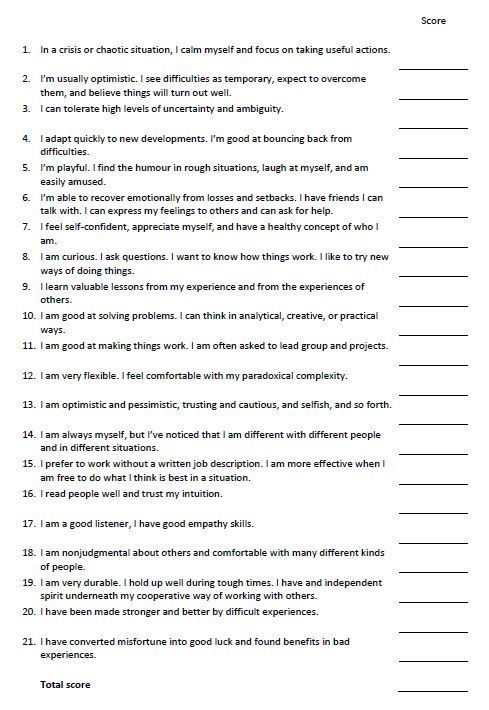
Now rate your own resilience (1 = very little; 5 = very strong):
Picture
From “The Resiliency Advantage” by Al Siebert.
​

Scoring :
Low score: A self rating score under 50 indicates that life is probably a struggle for you. You may not handle pressure well. You don’t learn anything useful from bad experiences. You feel hurt when people criticize you. You may sometimes feel helpless and without hope.
If these statements fit you, ask yourself “Would I like to learn how to handle my difficulties better”. If your answer is yes, then a good way to start is to meet with others who are working to develop their resilience skills. Let them coach, encourage and guide you. Another way is to work with a coach or a therapist. The fact that you feel motivated to be more resilience is a positive sign.

High score: If you rated yourself high on most of these statements you would have a score over 90. This means you know you are very good at bouncing back from life’s setbacks.
A question for you to consider is whether you feel willing to tell your story to others and make yourself available to people who are trying to cope with adversities. People learn from real-life role models. You could be one.

Middle scores: If you agreed with many of the statements and scored in the 70-89 range, then that is very good! It means that you are fairly resilient, but that you could become even more resilient and confident by paying attention to some of those factors that will make the difference.
If you scored in the 50-69 range, you appear to be fairly adequate, but you may be underrating yourself. A much larger percentage of people underrate themselves than overrate themselves on the assessment. Some people have a habit of being modest and automatically give themselves a 3 on every item for a total score of 60. If your score is in the 50-69 range, we need to find out how valid your self rating is.

In the next article, we will look at ways in which you can develop your own resilience, after which we will consider how you might enable your team to become more resilient.
​

Contact Me
Resilience has everything to do with how you think about things, so it is a completely coachable topic. If you recognise that you need to strengthen your own resilience, email me on [email protected] and let’s discuss your coaching programme.
0 Comments

Resilience, Grit and Mental Toughness - An Introduction

4/12/2022

0 Comments

 
The last couple of years have been difficult for most of us, and this has resulted in widespread mental health problems and a great deal of unhappiness. I happen to think that, while we collectively dealt with the challenges of a pandemic, the notion of life being difficult is ubiquitous. Life is difficult for different people in different ways and to differing degrees at different times. Yet some people rise above these challenges and others don’t do so well. This article is a continuation of a series that starts here.

Characteristics that are typically used in relation to being able to prevail in the face of challenges include Resilience, Grit and Mental Toughness. They are not all the same thing and not all people who do ok despite life’s difficulties have all of these characteristics. In this article, I explain the concepts and why they are important. In future articles I will talk about how to develop these characteristics. Here are some useful definitions:

1. Resilience
Wikipedia: Psychological resilience is the ability to cope mentally or emotionally with a crisis or to return to pre-crisis status quickly.[1] Resilience exists when the person uses "mental processes and behaviors in promoting personal assets and protecting self from the potential negative effects of stressors".[2] In simpler terms, psychological resilience exists in people who develop psychological and behavioral capabilities that allow them to remain calm during crises/chaos and to move on from the incident without long-term negative consequences.
Everydayhealth.com: Resilience is typically defined as the capacity to recover from difficult life events.
American Psychological Association: Resilience is the process of adapting well in the face of adversity, trauma, tragedy, threats, or significant sources of stress—such as family and relationship problems, serious health problems, or workplace and financial stressors. As much as resilience involves “bouncing back” from these difficult experiences, it can also involve profound personal growth.
Positivepsychology.com: Resilience can be defined as the ability – and tendency – to “bounce back.” “Bouncing back” is what we do when we face disappointment, defeat, and failure, but instead of wallowing or letting things keep us down, we get back up and continue on with our lives.

The common thread in these definitions is that resilience is what enables us to ride out the struggle and recover from negative life events. It does not shield us from experiencing pain – we experience the pain of these life experiences as one might expect – but it gives us the strength to get through it and rise again without breaking down or falling apart. Resilient people are not afraid of the pain because they know they will be fine, no matter what happens.

We need resilience because life is just damn difficult – and we need to be able ride out the tough experiences and bounce back from setbacks and tragedy. In the next article, I will discuss the life choices and actions that build resilience and how to put these in place.

2. Grit
Wikipedia: In psychology, grit is a positive, non-cognitive trait based on an individual's perseverance of effort combined with the passion for a particular long-term goal or end state (a powerful motivation to achieve an objective). This perseverance of effort promotes the overcoming of obstacles or challenges that lie on the path to accomplishment and serves as a driving force in achievement realization.
South African College of Applied Psychology: Angela Lee Duckworth is quoted: “Grit is passion and perseverance for very long-term goals. Grit is having stamina. Grit is sticking with your future, day in, day out, not just for the week, not just for the month, but for years, and working really hard to make that future a reality.”
Psychology Today: If you're gritty, you attain success through endurance, perseverance, resilience, passion, hard work, and practice, practice, practice. If you persist and face all the obstacles, you may just win. It involves finding your passion (which involves a sense of purpose) and persevering.
New Harbinger Publications: It is the ability to persist in something you feel passionate about and persevere when you face obstacles. This kind of passion is not about intense emotions or infatuation. It’s about having direction and commitment. When you have this kind of passion, you can stay committed to a task that may be difficult or boring.  

As you can see, the essence of grit is a sense of purpose – big goals that you feel passionate about – and the perseverance to stick with it until the goal is achieved, no matter what obstacles you might face.

Without Grit, one cannot get the big goals achieved. It is about being driven towards something important and having the determination to see things through. I think that grit requires that one is actually resilient – but not all resilient people also have grit.

3. Mental Toughness
Mental Toughness is a concept that has emerged from the field of sports psychology, but I think it can be applied far more broadly. It is not the same as resilience. Here is my definition:

Mental toughness is the ability to sustain consistent focus and self-belief under difficult circumstances and despite external distractions and challenges. It has four components:
  1. Control: the sense that one has the ability to influence in a situation while keeping one’s emotions in check;
  2. Commitment: the choice to stay deeply involved in pursuing challenging goals despite the difficulties that may arise;
  3. Challenge: seeing potential threats as an opportunity for self-development and continuing to strive despite a constantly changing environment.
  4. Confidence: in one’s capabilities as well as in one’s ability to navigate complex interpersonal settings.
(For more see Frontiers in Psychology).

It is most easily demonstrated in the world of sport:
  • The tennis player who makes no errors despite a hostile crowd and an opponent who is relentless. Rafael Nadal springs to mind;
  • The rugby player who will practice kicking for posts for hours at a time, even without the presence of the coach, like Jonny Wilkinson;
  • The golfer who is able to sustain focus over 2 or 3 days despite searing heat or howling wind. Ernie Els is a great example.
It would appear that mental toughness is about the ability to “mind your mind” despite relentless pressure. In the world of work, it is demonstrated by the CEO who stays calm, focused and continues making good decisions and communicating well despite constant surprises and curved balls. I think Andre de Ruyter, Eskom CEO, is a great example of a business leader who is mentally tough.

Once again, mental toughness is only possible in the presence of resilience – but being resilient does not necessarily make one mentally tough.

In the next few articles, I am going to explore each of these concepts and examine whether and how they can be developed or learned. So stay with me.
​
Contact Me
If you are in a chapter of your life where success requires that you are resilient, gritty or mentally tough, the support of a coach is very powerful. If this is you, why don’t you email me on [email protected] and let’s discuss your coaching programme.
0 Comments
<<Previous

    Categories

    All
    20Plenty
    Accountability & Responsibility
    Adaptability
    Authentic Conversations
    Belinda Davies
    Celebrate Success
    Change
    Coach
    Coaching
    #coaching
    Conversation
    CPD (Continuing Professional Development)
    Culture
    Culture Change
    Decision Quality
    Diversity
    Emotional Regulation
    Empathy
    Empathy Is Not Intuition
    Employeeengagement
    Employee Engagement
    Employee Survey
    Endurance
    Engagement
    Ethics & Ethical Dilemmas
    Focus
    #goals
    Gratitude
    Grit
    Health
    Influence
    Inspiration
    Inspirational Leadership
    Inspiring Others
    Leaders As Coaches
    Leadership
    #leadership
    Leadership Development
    Leadership Skills
    Leadership Solutions
    Life Is Difficult
    Management
    #management
    Managers
    Managers As Coaches
    Managers-as-coaches
    Mental Health
    Mental Toughness
    Motivation
    New Beginnings
    Optimism
    People Who Thrive
    Performance
    Performance Under Pressure
    Personal Leadership
    Planning
    Professional Supervision
    Reinvent Yourself
    Relationships
    Relationships Matter
    Resilience
    Rules Of Engagement
    Self-acceptance
    Self Awareness
    Self-awareness
    Self Care
    Self Leadership
    Self-Leadership
    Self-love
    Self Mastery
    Self-mastery
    Self-worth
    Servant Leadership
    Staying The Course
    Strategic Leadership
    #success
    Team_resilience
    Teams
    The Discipline Of Leadership
    Thrive
    Trust & Trustworthiness
    Values
    Victimhood
    Victim Mentality
    Victim Mindset
    Vision
    Winning Mindset

    Archives

    March 2024
    February 2024
    July 2022
    June 2022
    May 2022
    April 2022
    March 2022
    February 2022
    January 2022
    December 2021
    November 2021
    October 2021
    September 2021
    August 2021
    May 2021
    April 2021
    March 2021
    February 2021
    January 2021
    November 2020
    October 2020
    September 2020
    August 2020
    July 2020
    June 2020
    May 2020
    April 2020
    March 2020
    February 2020
    January 2020
    October 2019
    September 2019
    May 2019
    March 2019
    January 2019
    February 2018
    April 2017
    December 2015
    November 2015
    October 2015
    September 2015
    August 2015
    July 2015
    May 2015

    RSS Feed

Whats Next?

Leadership Development
Executive Coaching
Business Strategy

What my clients say

Articles
    Work We've Done
    Self-leadership
    Strategic Leadership
    Strategic Thinking
    Strategy

Call me! 082 5519504
Picture
Picture
Picture

    What improvements or changes do you seek?

Submit